

What each run can access
Scheduled Tasks run as the person who created them. Each run uses that person’s current:- Onyx permissions and company knowledge access.
- Connected Apps and external-account permissions.
- Available Skills.
- User Library files.
A Scheduled Task does not automatically send you its result. If the output should go to Slack, Gmail, Google Drive,
or another destination, say so in the prompt and configure that App for unattended use. Otherwise,
review the output from the task’s run history.
Create a Scheduled Task
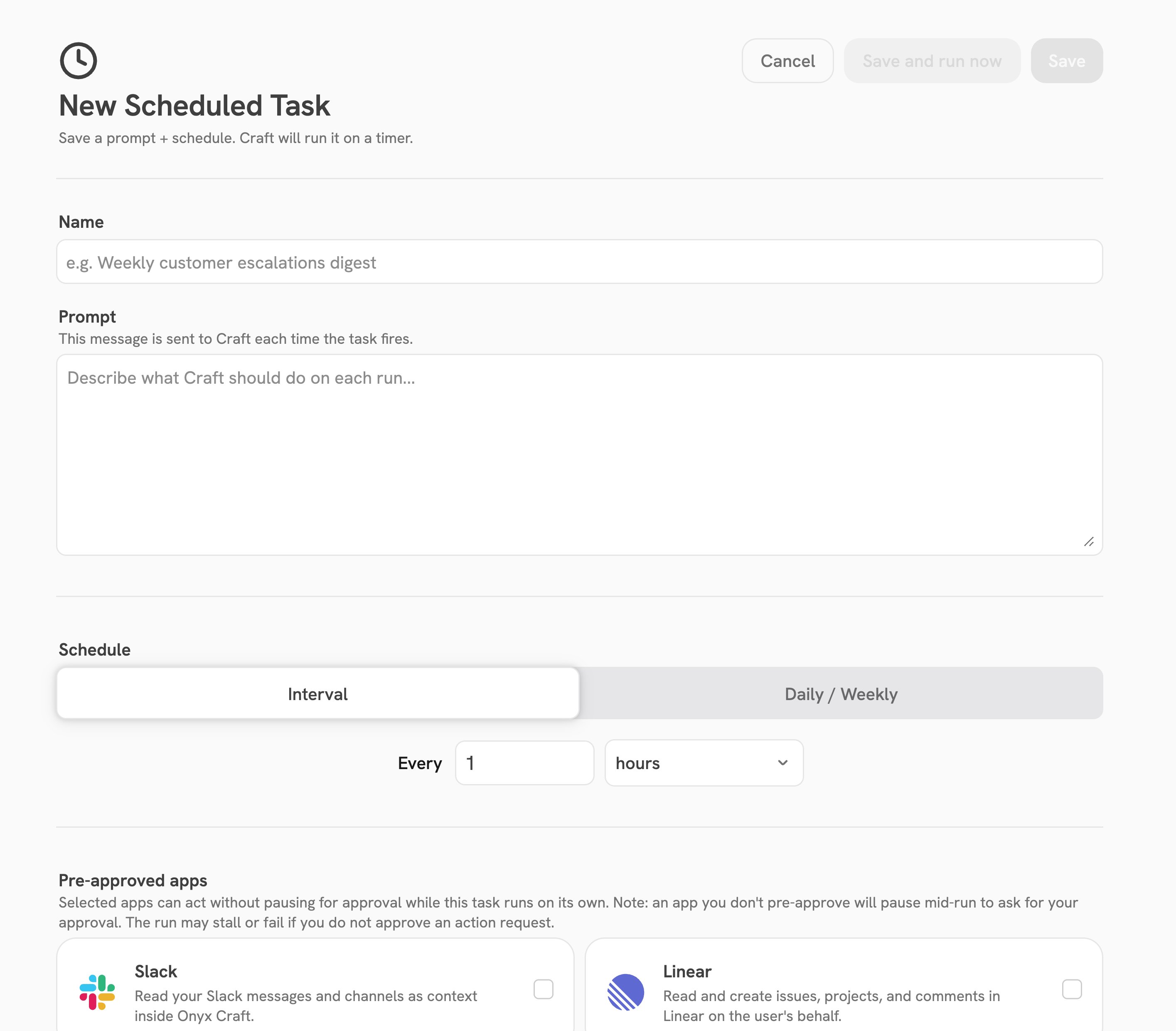
Open Scheduled Tasks from the Craft sidebar, then select New Scheduled Task.1
Name the task
Use a name that makes the cadence and result easy to recognize, such as “Weekday customer escalations digest.”
2
Write a self-contained prompt
Describe what Craft should inspect, the time window, what qualifies for inclusion, the desired output,
and where to deliver it. Type / to select a specific Skill or connected App from the prompt picker.
3
Choose a schedule
Use Interval to run every set number of minutes or hours. Use Daily / Weekly to choose a time and,
optionally, specific days of the week.
4
Review pre-approved Apps
Select only the Apps the task must use without you present. Connect required Apps before creating the task.
5
Save and test
Select Save to wait for the next scheduled time, or Save and run now to queue the first run immediately.
Write a prompt that can run unattended
Craft cannot ask you a useful follow-up while a Scheduled Task runs in the background. Front-load the decisions it would otherwise need from you:
For example:
Review the#customer-escalationsSlack channel and open P1 issues in Linear for activity from the last 24 hours. Include only items that are blocked, overdue, or need an executive decision. Group them by account and list the owner, impact, and next step. Post the final digest to#support-leads. If nothing qualifies, post “No new escalations.”
Understand schedule timing
Daily and weekly times are interpreted using your browser’s local time when you save the task. Interval schedules run on repeating clock boundaries rather than a fixed delay after the previous run finishes.The saved schedule does not automatically adjust when your UTC offset changes.
Review and resave time-based tasks after traveling, changing time zones, or a daylight-saving transition.
Pre-approve Apps carefully
App actions configured as Ask normally pause for your approval. Because a Scheduled Task runs unattended, selecting an App under Pre-approved Apps allows the task to perform those actions without asking during the run.
Pre-approval applies to the App, not to one specific action. If you pre-approve Slack, for example,
any Slack action governed by Ask can run when it matches the task prompt and the connected account’s access.
For more about connections and action policies, see Apps.
Review run history
Open a task to see its pre-approved Apps and run history. The table shows when each run started, its status and duration, a short summary, and whether it came from the schedule or Run now. Select a run after it creates a session to inspect its messages, files, previews, and artifacts. Queued runs do not have a session yet, and skipped runs never create one, so those rows cannot be opened.
Watch for Onyx notifications when a run fails or reaches Awaiting approval.
Failed and approval-blocked runs are not retried automatically.
Manage a task
From the task detail page, you can:
Deleting a task does not cancel a run that is already queued or running.
If you only need to stop future runs temporarily, pause it instead.
Troubleshooting
A run succeeded, but I did not receive anything
A run succeeded, but I did not receive anything
Open the run session from history and inspect its output. If the task should deliver somewhere else,
add an explicit destination to the prompt, connect that App,
and pre-approve it when the delivery action uses Ask.
A run was skipped
A run was skipped
Check the row summary. If the previous run was still queued or running,
make the prompt smaller or use a less frequent schedule.
A run can also be skipped when Craft is disabled for the task owner.
A run failed
A run failed
Open the generated session when available. Confirm required Apps are still connected,
Skills and User Library files still exist, and the prompt can finish within one run. After correcting the task,
select Run now.
The task ran at an unexpected time
The task ran at an unexpected time
Daily and weekly schedules use the browser’s local time at save time.
Edit and resave the task after a time-zone or daylight-saving change. For an interval schedule,
remember that runs align to repeating clock boundaries.
Connect Apps
Connect delivery destinations and understand approvals before running work unattended.
For admins
Enable Craft and review the deployment, worker, App, and governance requirements.